@4x-1-scaled-120x22.png)
Spherefix Compact GNSS Receiver Buying Guide — Compact Body, Professional Performance
24 March 2026
Spherefix Compact GNSS Receiver – Small Body, Professional Survey Power
As a long-time global user of surveying equipment, I’ve watched the industry shift toward portable, miniaturized tools that fit mobile mapping, narrow-space jobs, cross-region work, and emergency projects. Traditional big, heavy GNSS receivers are just too hard to carry and use in tight spots. That’s why the Spherefix compact GNSS receiver quickly became my go-to choice for fieldwork worldwide. It packs professional RTK performance into a tiny, easy-to-carry body, solving so many pain points for small engineering, mobile mapping, and cross-border jobs. Today I want to share my real-world experience with the Spherefix compact GNSS receiver lineup — SP35, SP35Se, SP35Pro — and show you how this compact device delivers true professional surveying power.
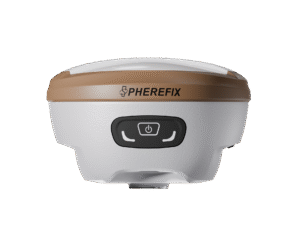
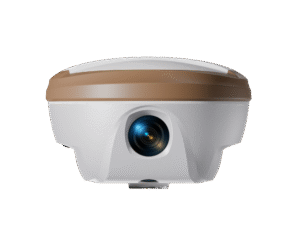
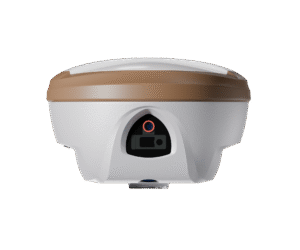
| Weight comparison of GNSS Recievers | | Spherefix SP35 series | |
|---|---|---|
Modell | Image | Gewicht (g) |
SP35Se |
| 750 |
SP35Pro |
| 770 |
SP35 |
| 780 |
Why We Love the Spherefix Compact GNSS Receiver
Ultra-Light & Compact Build
Every Spherefix compact GNSS receiver in the SP35 series weighs under 800g, making fieldwork far less tiring.
With a tough magnesium alloy shell and tight, smart internal layout, this Spherefix compact GNSS receiver is built to last but still light enough for all-day use. You can mount it on a pole, hold it in hand, or toss it in a backpack — perfect for rooftop stakeout, narrow alley construction, and long-distance field surveys.
Centimeter-Level Precision You Can Trust
Don’t let the small size fool you. This Spherefix compact GNSS receiver delivers professional-grade accuracy that beats many bulkier devices:
Static: Horizontal ±(2.5mm+1ppm), Vertical ±(5mm+1ppm)
RTK: Horizontal ±(8mm+1ppm), Vertical ±(15mm+1ppm)
60° tilt compensation: ≤2cm
With 1408 high-speed channels tracking BDS, GPS, GLONASS, Galileo, QZSS, SBAS, and NavIC, the Spherefix compact GNSS receiver holds a strong, stable signal even in cities, forests, and high-altitude areas.
Centimeter-level Accuracy | All-Constellation Tracking
All-Day Battery & Low-Power Design
The built-in 7.4V 6500mAh battery keeps this Spherefix compact GNSS receiver working for over 16 hours in typical rover mode. Paired with C100T or C500 controllers (9000mAh, up to 18 hours), you can work an entire day without stopping to recharge. The ARM Cortex-A7 Linux system runs smoothly while saving power, a huge plus for remote field jobs.
IP68 Rugged Build for Any Climate
This Spherefix compact GNSS receiver carries an IP68 rating, meaning it’s waterproof, dustproof, and shockproof — it can even survive a 2m drop on a pole. It works reliably from -30°C to +65°C and stores safely from -40°C to +85°C. I’ve used it in tropical humidity, freezing cold, dry deserts, and salty coastal areas, and it never lets me down.
IP68 Waterproof & Dustproof | -40°C to +85°C
How Spherefix Compact GNSS Receiver Beats Ordinary Models
From my field experience, regular compact GNSS receivers often lack satellite support and signal stability. Not the Spherefix compact GNSS receiver. It tracks all global navigation systems, so you get faster fixes and stronger anti-interference.
It also comes with 4G full-netcom, Bluetooth, Wi-Fi, and a 1.5W LoRa radio that reaches up to 10km in open areas. It supports global voltage, frequency, and software standards, so you can use it anywhere right out of the box.
Each Spherefix compact GNSS receiver offers modular features for different jobs:
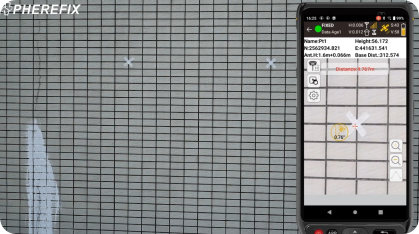
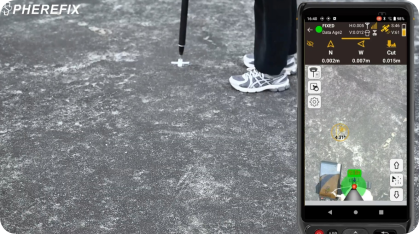
SP35: Camera-assisted laser survey + AR real-scene stakeout
SP35Se: AR real-scene stakeout for intuitive layout
SP35Pro: Photogrammetry + AR dual module for versatile mapping
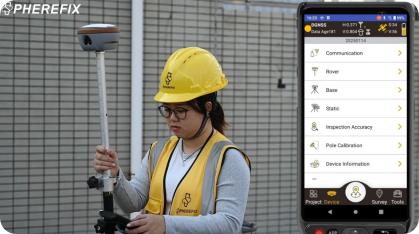
Real-World Global Use Cases
Europe & North America
I’ve recommended the Spherefix compact GNSS receiver to colleagues in the US, Germany, and France for small construction, urban stakeout, and landscape survey. Its compact size works great in city alleys and rooftops, and the precision meets strict regional standards.
Asia-Pacific
In Southeast Asia and Australia, teams use this Spherefix compact GNSS receiver for pipeline inspection, land registration, and infrastructure mapping. The long-range radio and 4G keep data stable even in remote areas.
Latin America
Archaeology and environmental teams in Brazil, Mexico, and Peru trust the Spherefix compact GNSS receiver for non-destructive site mapping. Its light weight eases field burden, and high precision protects sensitive data.
Global Emergency Survey
When disasters strike, the Spherefix compact GNSS receiver deploys fast for damage mapping and emergency assessment. Its rugged build and long battery make it ideal for harsh post-disaster conditions.
Final Verdict & Call to Action
After months of real-world use, I can honestly say the Spherefix compact GNSS receiver redefines what a compact survey tool can do. It’s ultra-light, precision-driven, globally adaptable, and built for real fieldwork.
If you’re looking for a compact GNSS receiver that doesn’t compromise on performance, the SP35 series is your best choice.https://spherefixgnss.com/product/sp35-gnss-receiver/
Check the full specs of the Spherefix compact GNSS receiver and claim your exclusive regional quote today!
 English
 French
 German
 Spanish
 Italian
 Portuguese
 Arabic
 Turkish
 Vietnamese